 EphemoraPublic beta
Know when the night is worth it.
Ephemora brings weather, darkness and astronomy into one view, so you can answer the questions that actually decide a night shoot: is tonight worth it, where should I go, and what time should I be standing there?
One answer instead of five apps.
Planning a night shoot usually means a weather app, a moon-phase app, a light-pollution map and a bit of mental arithmetic. Ephemora does that work and gives you one answer you can act on.
Tonight
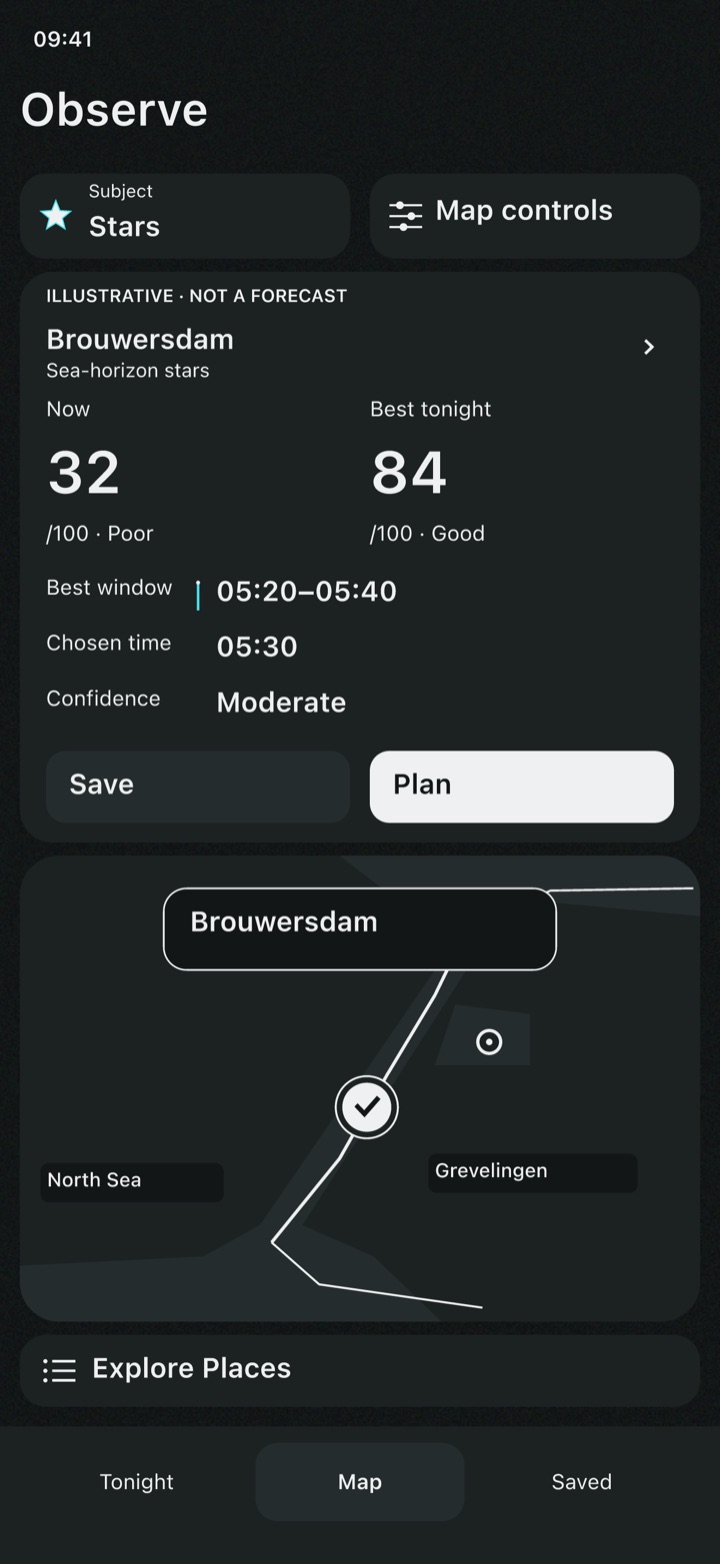
What the sky is doing now, and the best window later tonight — with the reasoning laid out: cloud cover, moonlight, darkness and how uncertain the forecast is. The best-window score is the average across that window, not a single peak moment. Plan for stars, the Milky Way, moonlight, meteors and golden hour.
Map
Scrub through time and compare nearby forecast conditions across three layers: photography conditions, cloud cover and estimated skyglow. Search for a place, or use your location if you choose — location access is optional. Map scores describe forecast conditions, not whether a place is safe, legal or publicly accessible.
Saved
Keep promising places close. Save locations from Tonight or Map and return to their Tonight forecast. Saved places stay on your device.
Every score shows its working.
Ephemora never hands you a number without the reasoning behind it. Open any recommendation and you can see exactly which conditions pushed it up or down.
- Cloud cover and precipitation are among the factors
- In Meteors mode, shower activity, closeness to the peak and the radiant’s position count towards the outlook
- Every score is guidance, not a guarantee — uncertainty is part of the answer, and longer-range forecasts are labelled by reliability
- Estimated skyglow shows relative artificial light from EOG VIIRS Nighttime Lights (VNL v2.2, CC BY 4.0). It is not a measured sky-brightness or Bortle reading
Weather forecasts are provided through Ephemora’s paid Open-Meteo API subscription. Weather data by Open-Meteo.com · CC BY 4.0. Estimated skyglow is derived from EOG VIIRS Nighttime Lights (VNL v2.2), 2025 annual composite, Earth Observation Group, Payne Institute for Public Policy, Colorado School of Mines · CC BY 4.0. Meteor-shower data from the International Meteor Organization. Astronomical calculations based on Jean Meeus, Astronomical Algorithms, 2nd edition.
Honest about the edges.
- It will not dress a forecast up as a fact
- It will not set your camera for you; exposure and settings are out of scope
- Ephemora cannot verify access or safety. Always check ownership, closures, terrain, tides and local restrictions before setting out.
Now testing through TestFlight.
Ephemora is available as a public TestFlight beta; it is not yet on the App Store. Join TestFlight, take Ephemora into real nights, and share what works, what feels unclear and what needs fixing. Public App Store release timing depends on what testing turns up.
Free covers the current night through a rolling 30-hour forecast, with up to three saved places. Ephemora Premium extends the forecast to ten days and lets you save more places. Monthly and annual subscriptions are offered through the App Store; prices and introductory-offer eligibility depend on your storefront and Apple Account.